News

Key Guidelines for the Oberer Schlossgarten Architecture Competition Reaffirmed
On Thursday, July 30, 2026, a jury meeting of the distinguished panel of judges was held as part of the ongoing architectural competition for the Littmann Ensemble at the Upper Palace Gardens.
With the aim of providing the 16 planning teams in the second phase of the competition with interim feedback to guide their further work, the respective design proposals were evaluated based on various criteria, such as cost-effectiveness, adaptability, sustainability, and urban openness.
From the very start of the process, the requirements for cost-effectiveness and flexibility—which are currently being emphasized by various parties—have been central guiding principles in the planning for the main site at the Upper Palace Gardens. They are a binding part of the ongoing competition process and are mandatory for all participating planning teams.
Interim feedback is a key component of the competition process, designed to do justice to the highly committed participants, ensure compliance with key planning assumptions, and enable optimal results for the final judging panel in December of this year.

© ProWST GmbH Stuttgart
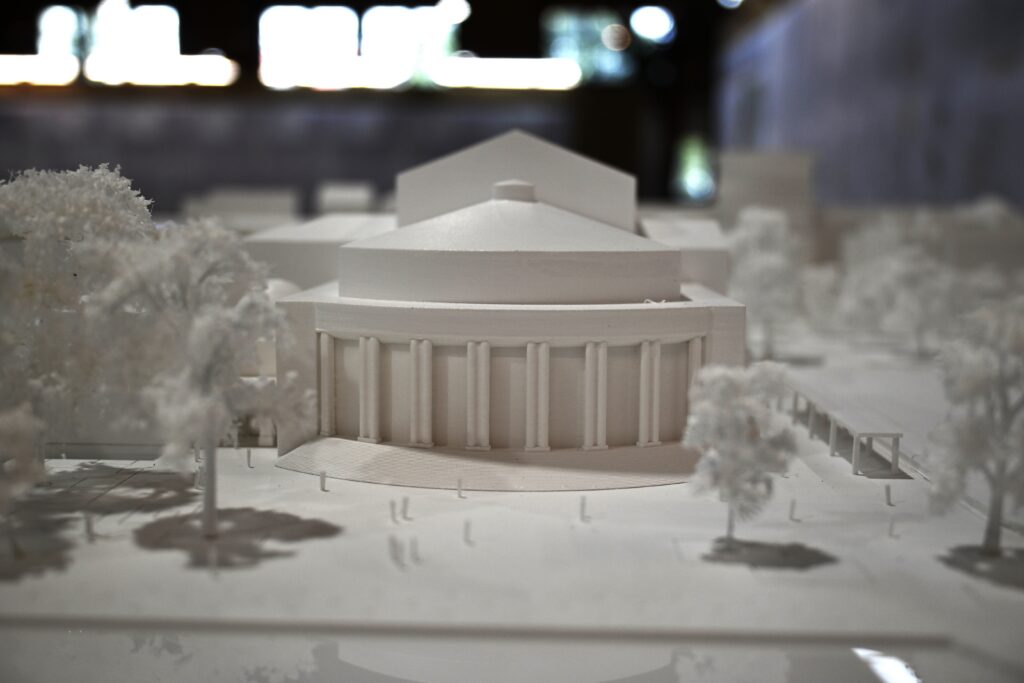
Decision on the Preliminary Project Plan for the Interim Site Postponed Until September
Following the space and cost savings at the interim site that were jointly identified over the past few months, the next planning step could have been taken by now. However, on Wednesday, July 29, 2026, the Stuttgart City Council’s Administrative Committee postponed the amendment to the preliminary project resolution until after the summer recess.
At the start of the meeting, Mayor Dr. Frank Nopper emphasized, with regard to the cost-cutting measures that had been implemented: “After years and decades of debate, and following the cost-cutting measures already implemented for the interim opera solution, we now need the courage to make decisions.”
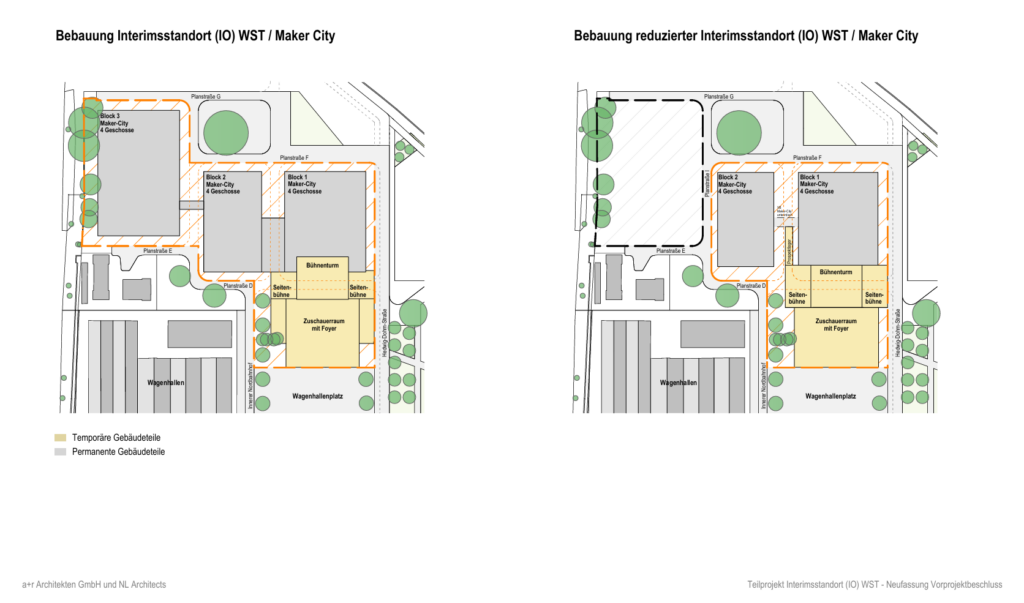
Over the past few months, the concept for the interim site has been extensively revised and significantly scaled back. The goal was to plan and implement only what was technically and legally necessary. The plans now available take cost-effectiveness into account and represent an important step toward limiting project costs.
“We have made considerable efforts, together with all stakeholders, to make the interim facility more cost-effective, streamlined, and efficient. We therefore regret all the more that the decision has now been postponed. Linking the interim site to a renewed review of the space allocation plan—which was agreed upon with all stakeholders just a year ago—and other planning details for the Littmann building creates additional dependencies between two subprojects that should be advanced swiftly and independently of one another. “This not only delays both projects but, given the trend in construction costs, will inevitably lead to further cost increases,” explains Christoph Niethammer, Managing Director of ProWST, .
Linking the two subprojects will make it difficult to establish a logical sequence for the project if urgent decisions regarding the interim phase are made contingent on issues that cannot be addressed in depth until much later planning phases of the overall project.
Furthermore, the requirements for cost-effectiveness and flexibility—which have been emphasized by various parties—are already central guiding principles in the planning for the main site at the Upper Palace Gardens. They are a binding part of the ongoing competition process and are required of all participating planning teams. In addition, the designs must be structured in such a way that they can adapt to changing spatial, operational, or staffing requirements and, if necessary, be scaled back further.
The Administrative Committee’s overwhelming support for the overall project, as well as its approval of the scaled-back plan for the interim site, are seen as positive signs for the project’s continued implementation.
The goal remains to move forward with the urgently needed renovation of the Württemberg State Theaters with a sense of proportion, cost-effectiveness, and a strong sense of responsibility.

Stuttgart Rosenstein: Construction Decision Expected for the Development of Maker City
The Stuttgart City Council is scheduled to approve the construction resolution on July 30. This will authorize the administration to award the necessary construction and planning contracts and enable the construction work to proceed. The sites are currently being prepared for development. Construction is scheduled to begin in early 2027.
The site development measures include the construction of roads as well as sewer and stormwater drainage systems, and will lay the groundwork for the further development of the neighborhood, which is being designed according to the principles of a “sponge city.” The goal is to retain stormwater on-site as much as possible, allow it to infiltrate the ground, and use it for irrigation. To this end, permeable paving, tree trenches, swales, and other blue-green infrastructure elements are planned, among other measures.
At the same time, the installation of geothermal probes for the use of sustainable geothermal energy is planned on the site of the future Wagenhallenplatz.
The City of Stuttgart is maintaining close communication with local stakeholders and residents both before and during the construction work. With the creation of Maker City, the first sub-area of Stuttgart Rosenstein is taking shape on the site surrounding the Wagenhallen, independent of the new train station’s opening. Over the coming years, this area is set to become an urban, creative, and livable neighborhood.
The Württemberg State Theaters’ temporary location will provide an important initial impetus for this new urban district.

Photo: C1 area near the Wagenhallen. Photo: City of Stuttgart. Credit: Fabrice Weichelt
Streamlined Interim Board of Directors Presented
On Monday, July 6, 2026, ProWST presented the revised plans for the interim location —commissioned by the state and the city—to the Board of Directors of the Württemberg State Theaters Stuttgart (WST). The revisions were prompted by the significant increases in construction costs in recent years, as well as the tight budgetary situation facing the state and the city.
All objectives were achieved: significantly reducing the costs for the temporary opera house on the C1 site near the Wagenhallen while ensuring on-time completion. As a result, the Board of Directors instructed ProWST to use the presented plans as the basis for further planning.
Working closely with the Württemberg State Theaters, ProWST developed a substantially revised concept for a more compact yet functionally viable alternative performance venue. The planned floor area was reduced by nearly 40 percent compared to previous plans. In addition, construction standards will be limited to what is functionally necessary. At the same time, it is ensured that the employees of the Württemberg State Theaters will continue to have access to an efficient and modern work environment in the future.
By reducing the building’s volume and simplifying the construction process, construction costs can be significantly reduced. In addition, the new concept helps ensure that the schedule is met: it saves time during both construction and planning. According to the current tentative schedule, the Württemberg State Theaters will be able to use the interim venue as planned starting in 2033. This means the key objectives for the redesign have been met.
The reason for this reorientation is the drastic increase in construction costs over the past few years—nearly 50 percent. Under these circumstances, it would not have been possible to stay within the originally estimated budget of 224 million euros. The revised implementation plan now on the table will offset a significant portion of these cost increases. According to current cost estimates, the total cost for the interim site will be around 289 million euros.
Petra Olschowski, Minister of Culture and Vice Chair of the Board of Directors, described the revised plan as a decisive step for the overall project: “This excellent proposal for a more streamlined and cost-effective interim venue is the key to the renovation, modernization, and expansion of one of the most beautiful opera houses in the world. The interim venue is the central element for the success of the entire project: Without the interim venue, artistic operations cannot be maintained continuously—more than that: without the interim venue, the very existence of the State Theater, with its world-class opera and ballet, is threatened.” The new plan lays the foundation for moving the project forward while simultaneously saving costs. All parties involved have supported the process with a strong sense of responsibility and through close collaboration, according to Olschowski.
ZusammenLebenFestival 2026 in Stuttgart
The ZusammenLebenFestival took place for the first time from June 19 to 20, 2026, at the Kunstverein Wagenhalle e. V. in Stuttgart. The goal of the event was to highlight solidarity-based, sustainable, and inclusive forms of communal living and to promote professional and social exchange. The festival was characterized by a wide variety of presentations and an open, inclusive atmosphere.
ProWST was represented with an information booth on the renovation project for the Württemberg State Theaters in Stuttgart. A thematic connection to the festival arose from its geographical proximity: Starting in September 2026, development work will begin on the Wagenhallen site for the so-called Maker City as well as for the State Theaters’ interim location.
The alternative venue is more than just a temporary solution. Once the opera and ballet return to the renovated opera house on the Upper Castle Gardens, significant portions of the building’s infrastructure are to continue to be used in the long term in the new Stuttgart Rosenstein district.
In particular, the planned repurposing of the backstage areas is in line with the festival’s themes. About two-thirds of the structures are to be converted into Maker City, where they will contribute to sustainable neighborhood development. Plans include spaces for the creative industries, workshops, housing, and community uses.
The architectural design of the stage, auditorium, and lobby also follows the principle of circular construction: they are built using a method that allows for dismantling, enabling the materials to be reused later.
The area around the Wagenhallen is already being used as a venue for art, culture, and community gatherings. The principles of openness, inclusion, and communal living experienced during the festival will thus find their spatial continuation in the emerging urban neighborhood.
The ZusammenLebenFestival has demonstrated the potential inherent in communal and inclusive forms of housing and living, as well as the significance of these concepts for future urban development processes.


16 teams advance to the second phase of the “Oberer Schlossgarten” project
The Littmann Building, constructed in 1912 and designated a historic landmark, is set to undergo a comprehensive renovation, modernization, and expansion—one of Germany’s most significant cultural projects. The goal is to preserve its architectural heritage while creating a sustainable environment for the arts, the public, and staff.
As part of a two-phase international architectural competition, 30 renowned design teams from across Europe submitted their initial proposals. A high-level jury has now selected 16 teams to advance to the second phase. The evaluation focused in particular on functionality, urban design quality, cost-effectiveness, and adaptability.
The project pursues several goals simultaneously: to secure the international appeal of the Stuttgart State Theaters, to create safe working conditions for approximately 1,400 employees, and to enable sustainable solutions through cost-conscious planning.
Particularly exciting: From an urban planning perspective, there was a desire to enhance the public space along the B14. In the future, new public spaces are to be created here that will shape Stuttgart’s cultural mile and connect the cultural hub even more closely with the city.
In December, the jury will meet again to select the final winning design for the world’s largest three-genre theater.


1. Photo: The architectural team for the “Oberer Schlossgarten” project with Managing Director Christoph Niethammer.
2. Photo: The architectural team for the “Oberer Schlossgarten” project with Managing Director Christoph Niethammer, Petra Olschowski, and Claudia Rose (MWK)
Participation in the Youth Forum in Stuttgart North
Right next to the young people of Stuttgart Nord, Maker City is taking shape—part of the new Stuttgart Rosenstein district.
The first building block will be the interim location of the Württemberg State Theaters on the C1 site near the Wagenhallen.
What is a temporary opera house? And what might a new name for it look like?
The ProWST team designed three activities for the Youth Forum to inform and engage local youth about this significant project in a playful way. Through the VR experience “Factory Run,” the opera quiz “Swipe Check,” and the naming contest “Battle of Names,” the young people were able to approach the topic of the opera house renovation in true gamer style and submit their own name suggestions for the temporary opera house.
The hall at the Kinder- und Jugendhaus Nord was packed, and the young people clearly enjoyed trying out the stations and sharing their own perspectives.
In additional workshops, the youth addressed topics that particularly affect their daily lives: safety in Stuttgart North at night, what works well or poorly with public transportation, as well as favorite spots and problem areas in the neighborhood. In direct dialogue with the Stuttgart Youth Council and the District Council, concerns were openly addressed, questions were asked, and possible solutions for the neighborhood were sought together.
The results of the Youth Forum will be presented on April 27 at the residents’ meeting in Stuttgart North.
The Youth Forum was organized by the Coordination Office for Youth Participation of the State Capital Stuttgart and the Youth Policy Department of the Stadtjugendring Stuttgart e.V.


Plans Become Reality: Progress in Subarea C1
On construction site C1, surrounding the Wagenhallen, development of the future interim location for the Württemberg State Theaters (WST) and the Maker City for Stuttgart Rosenstein is clearly gaining momentum. Following intensive preparatory work, site development has begun. The temporary opera house serves as the first building block for the new Stuttgart Rosenstein district. In addition, an urban mix is emerging here in which living, working, and creative endeavors are closely intertwined: the neighborhood hub with an energy center, as well as the neighborhoods of the “eco- and social pioneers” and the “pioneers of urban production,” which will eventually tie in with the opera’s use of the space.
Key infrastructure requirements have already been put in place over the past few months. For example, the main drinking water pipeline has been successfully laid, and the route of the local heating network has been revised—an important step, as Maker City will be supplied with local heating, among other things, in the future. A geothermal energy supply has also been secured for the temporary opera house, which will be provided via a geothermal well field at Wagenhallenplatz.
The site will be fully cleared during 2026. This includes the careful relocation of strictly protected species such as the wall lizard, which is expected to be completed by September 2026. From that point on, development work will begin in subarea C1—a crucial phase in which the conceptual plans will gradually be transformed into a physical reality. First, the access roads will be built, connecting the lots and buildings and linking them to essential utility lines such as water, sewer, electricity, and internet. The contracts for road construction, sewer, and utility line installation will be put out to bid and awarded to construction companies—the foundation for construction work to officially begin in September 2026.
A glance at the aerial view of the subarea already reveals the clear structure of the various building sites, which are being developed step by step. Building sites 1 through 3 will initially house the WST’s interim location; once the interim use ends, this area will be further developed for the “Pioneers of Urban Production” neighborhood. The goal here is to create a vibrant urban neighborhood that combines much-needed housing with spaces for production, crafts, and services in an urban setting. Building site 4 plays a central role: this is where the neighborhood hub and the energy center—the infrastructural focal points of the entire site—will be built. On construction sites 5 through 7, meanwhile, the “eco- and social pioneers” neighborhood is taking shape, where new forms of communal living and sustainable coexistence will be tested and established.


Photos: Fabrice Weichelt/City of Stuttgart
Maker Baker City & the Gingerbread Opera House on Display Until February 1st
The "Winter Wonderland Gingerbread City" exhibition at StadtPalais Stuttgart has been extended until February 1, 2026!
During the pre-Christmas get-together of the communication teams from Stuttgart Rosenstein and ProWST, we recreated the centerpiece of the new Stuttgart Rosenstein district in gingerbread. We are thus joining the emerging gingerbread movement in Stuttgart and are a proud part of the enchanting gingerbread exhibition "Winter Wonderland Gingerbread City" at the StadtPalais – Museum for Stuttgart.
The first floor of the museum will transform into a fragrant winter wonderland until February: Approximately 30 gingerbread models showcase imaginative architecture and well-known Stuttgart landmarks – designed by citizens and ten Stuttgart architectural firms.
With the new Stuttgart Rosenstein district, an 85-hectare space for future development and creativity is being created. The first and central element of the future district will be the temporary opera house (interim venue). Here, the opera and ballet divisions of the Württembergische Staatstheater Stuttgart will perform during the renovation, modernization, and expansion of the historic opera house on the Upper Palace Gardens. After the interim period, the site will be used for the Maker City – an investment in the future of the new district.


Technical Excursion to the Interim Venue of Staatstheater Kassel
On October 31, Giuseppe Verdi's „Aida“ premiered at the new INTERIM of the Staatstheater Kassel – thereby inaugurating a temporary venue designated for at least six years.
One week later, we had the opportunity to meet the team led by Artistic Director Florian Lutz on site.
From the outside, the modular building in the south of Kassel resembles a simple production hall. However, upon entering, an unexpectedly fascinating space unfolds: a modular theater that impresses with its creativity, flexibility, and boldness. The centerpiece is a four-story audience gallery constructed from scaffolding, which is far more than just seating – it becomes part of the staging itself. The stage areas are variable, complemented by an overhead machinery system with 28 hoists, a heavy-duty turntable, and a coverable orchestra pit. The 25 by 50 meter hall can accommodate up to 850 people; it can be utilized as an immersive arena, a classic proscenium stage, a spatial stage, or in a longitudinally oriented stage format. Furthermore, due to its consistent multifunctionality and modular construction, the entire building can be completely dismantled, reassembled at another location, or further developed as needed.
And what makes the INTERIM so artistically unique?
In non-frontal stage designs, the traditional separation between the stage and the audience can be eliminated. Everything is modular, everything is in motion: The stage can be arranged differently for every production; the audience sits in front of it, behind it—or even on the stage itself. Democratic, participatory, and as accessible as possible. Seats on the stage can be booked through the “Adventure Subscription.” They promise a theater of experience, with the excitement of a premiere and a spirit of adventure—and demand is high!
In addition to these inspiring impressions, we particularly note this message:
The Staatstheater Kassel and Stuttgart have very different requirements.
And in discussions with the artistic directorate, it was emphasized: Stuttgart enjoys enormous prestige and renown in the theater industry. Stuttgart is a constant benchmark for the German opera world. Everyone looks to Stuttgart.
This appreciation is both an incentive and a responsibility.