Decision on the Preliminary Project Plan for the Interim Site Postponed Until September
Following the space and cost savings at the interim site that were jointly identified over the past few months, the next planning step could have been taken by now. However, on Wednesday, July 29, 2026, the Stuttgart City Council’s Administrative Committee postponed the amendment to the preliminary project resolution until after the summer recess.
At the start of the meeting, Mayor Dr. Frank Nopper emphasized, with regard to the cost-cutting measures that had been implemented: “After years and decades of debate, and following the cost-cutting measures already implemented for the interim opera solution, we now need the courage to make decisions.”
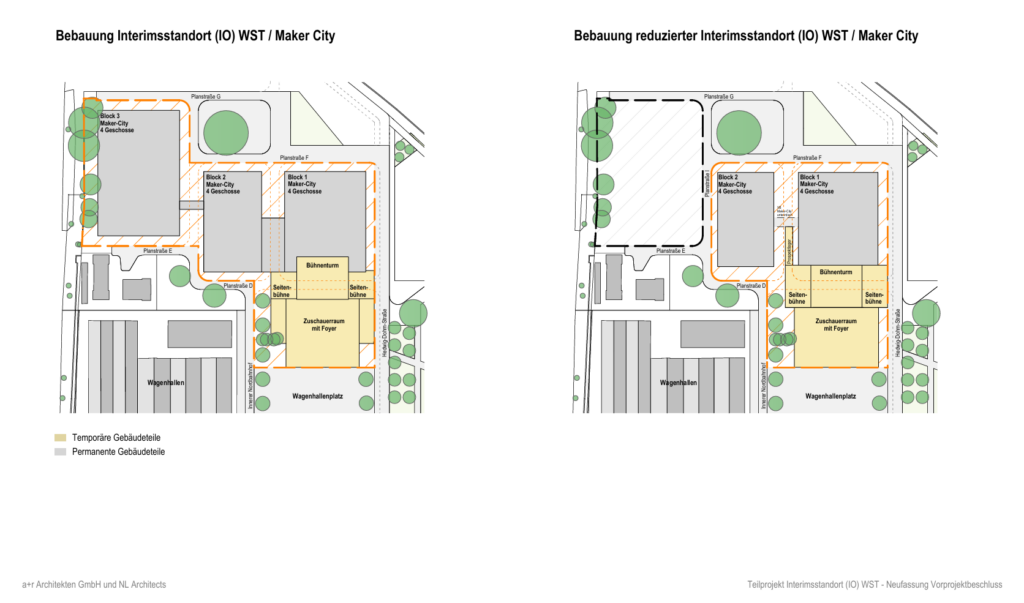
Over the past few months, the concept for the interim site has been extensively revised and significantly scaled back. The goal was to plan and implement only what was technically and legally necessary. The plans now available take cost-effectiveness into account and represent an important step toward limiting project costs.
“We have made considerable efforts, together with all stakeholders, to make the interim facility more cost-effective, streamlined, and efficient. We therefore regret all the more that the decision has now been postponed. Linking the interim site to a renewed review of the space allocation plan—which was agreed upon with all stakeholders just a year ago—and other planning details for the Littmann building creates additional dependencies between two subprojects that should be advanced swiftly and independently of one another. “This not only delays both projects but, given the trend in construction costs, will inevitably lead to further cost increases,” explains Christoph Niethammer, Managing Director of ProWST, .
Linking the two subprojects will make it difficult to establish a logical sequence for the project if urgent decisions regarding the interim phase are made contingent on issues that cannot be addressed in depth until much later planning phases of the overall project.
Furthermore, the requirements for cost-effectiveness and flexibility—which have been emphasized by various parties—are already central guiding principles in the planning for the main site at the Upper Palace Gardens. They are a binding part of the ongoing competition process and are required of all participating planning teams. In addition, the designs must be structured in such a way that they can adapt to changing spatial, operational, or staffing requirements and, if necessary, be scaled back further.
The Administrative Committee’s overwhelming support for the overall project, as well as its approval of the scaled-back plan for the interim site, are seen as positive signs for the project’s continued implementation.
The goal remains to move forward with the urgently needed renovation of the Württemberg State Theaters with a sense of proportion, cost-effectiveness, and a strong sense of responsibility.